Wednesday, August 25, 2010

Jackson Wyoming August 13-20

The drive took a while due to miles of construction, but the sight of the Grand Tetons in the distance was majestic.


The KOA campsite in Jackson was crowded—Ray did an exceptional job fitting the trailer in a limited space. We stayed for two days.


We moved downtown to the Virginian RV campground for the rest of our stay.


Our first foray into the Grand Teton National Park brought us to Jenny Lake. While hiking toward Inspiration Point, I snapped pictures of Hidden Falls and vistas from the trail. Very pretty.


We visited local bars and museums (below is a picture taken outside the National Museum of Wildlife Art), but our next major outing was a one hour trail ride at Teton Village.


On the way back we saw a moose in the wild and stopped on the side of the road to take a picture.


(Actually we saw lots of wildlife at Jackson during our stay. See below)


Later that afternoon we watched rafts navigate white water on the Snake River. This is the Snake River at a calm spot.


We returned to Grand Teton National Park to drive up Signal Mountain and stop at Jackson Lodge for lunch.

The view from Signal Mountain Road


A picture of us taken a few feet from our luncheon table.

Dinner on our last night was at the Gun Barrel where we feasted on Bison Carpaccio, Venison Sausage and fried green tomatoes. Yum.

Buffalo & Dubois, Wyoming August 7-13

Our first impression of Wyoming was dry, dry, dry.


The landscape was desolate until we reached the Big Horns.


Our campsite in Buffalo was fine for a few days stopover.


Then it was on to Dubois. It seemed that every 50 miles brought a new landscape.


The entry into the Dubois Wind River KOA campground was impressive.


The Wind River was right behind our campsite so we listened to running water our entire stay.


We took a drive to a fish hatchery and saw very different scenery.


We also visited the Sheep Interpretive Center and toured the Dubois Museum before departing for Jackson.

Friday, August 6, 2010

Custer SD July 31 to August 7

We set up our trailer at Custer’s Gulch Campground, situated in the actual valley that Custer used for his camp in 1874, two years before Little Big Horn.


Our first tourist excursion was to Crazy Horse. It’s an impressive sculpture, but I can’t help thinking it will never be finished. It’s taken over 60 years to sculpt the face and the plan calls for the entire man and horse.


Mount Rushmore via Iron Mountain Road was next. Hairpin turns, one lane tunnels and huge drops on the side of the road. The tunnels framed Mount Rushmore (look closely).


Ray would like me to add one picture here. As the driver, he felt he had our lives in his hands. More than once our demise flashed through his mind. He could even see “the light at the end of the tunnel”. ☺


Mount Rushmore was really impressive and we managed to get a picture of the two of us together!

The following day we did Needles Highway-- more white-knuckle driving (hairpin turns one-lane tunnels and huge drops) and more spectacular scenery. Ray did a great job.


Our next drive was the wildlife loop in Custer State Park. We saw prairie dogs and two kinds of deer, but we interacted with burros and buffalo.


Our last major drive was to Hot Springs. On the way we had our best sighting yet of a prairie dog. He was about a yard away from the car.


Our destination was the Mammoth Site, a paleontologist’s dream. Fifty-nine creatures have been found, captured for all time in a sink hole. The ice age animal remains are left in situ for everyone to see.


On the way home, we stopped at the Wind Cave. The one and a half hour tour (300+ steps) showed lots of “boxwork”, an odd form of stalactite.


On our last full day in Custer, we visited the Custer County Museum which holds many wonders. There was a great display of Custer photographs and the taxidermy room showed the difference between animals stuffed now vs those stuffed 100 years ago. Compare the cats--both are mountain lions.


We would recommend the Black Hills to anyone. We barely touched the surface, not having the chance to visit the Deadwood area because motorcyclists are already filling the area campgrounds in preparation for the Sturgis rally. The rally has not yet begun, but we already see the effects over 70 miles away.

Sunday, August 1, 2010

Ray’s Random Rambling Reflections II – July 2010

Another month has suddenly passed and already it is my turn to “make an entry in the blog”. Maintaining a blog is really fun – and easy. For me, it is also a humbling experience to be writing in a medium that will be preserved for at least a thousand years. Imagine! Some alien could actually be inspired to research how humans lived eons ago - and they could be using my writing as a helpful insight!

For those who are keeping track of the numbers, as of August 1, we have added a total of 6,423 miles on the truck! It’s all good - and we continue to press westward – and to enjoy one of the best times of our life!

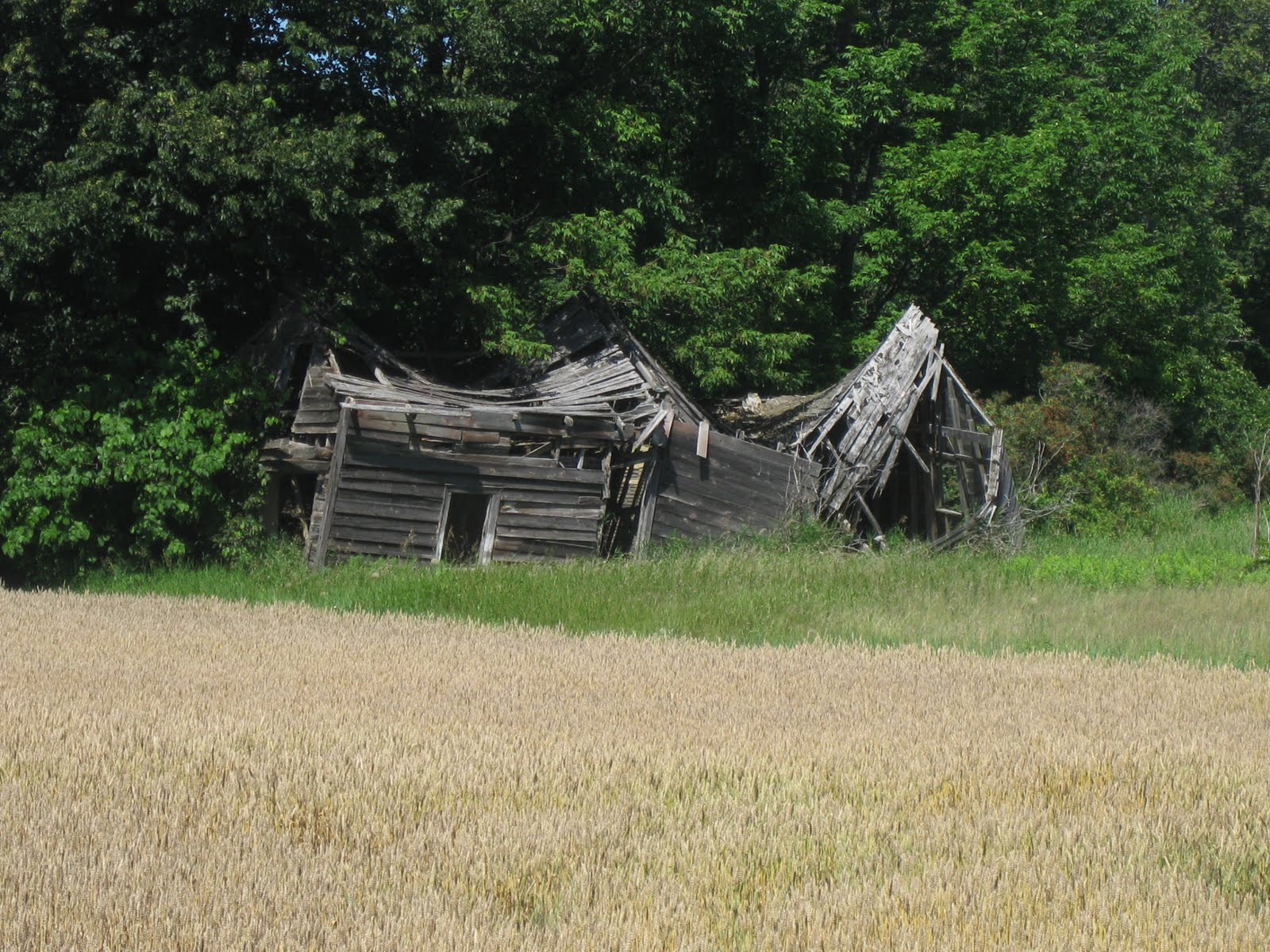
One impression I want to share with our readers, who are now referred to as “followers” in blog terminology, is what I see as the apparent economic decline of rural America. The number of abandoned and collapsing barns and farmhouses we see is shocking. Many “for sale” signs on the main streets of small towns also leave me wondering about economic prosperity in rural America. As we trace the backyard of America, the only successful commerce seems to be vineyards, health services, and occasional tanning salons.


Could we be witnessing the economic decline of America from the extremities to the core - something like a human’s response to hypothermia? Is the economic life blood of America retreating from the rural areas to nourish the big cities? And who is feeding America, if so much of our farmland is decaying?” Of course the monolithic farms of states like Illinois and Ohio may be thriving, but the cumulative effect of so many collapsing smaller farms in states like New York, Pennsylvania, and Michigan, should account for less food products on our shelves.
Maybe improvements in technology partially offset the decline in number of farms – that is, something like “more yield per acre or per animal”. When we toured a giant dairy farm in Ohio, we learned that the cows are mechanically milked three times a day, 24 hours a day, seven days a week – except during the occasional period when they are calving. What we were told by Mr. and Mrs. Farmer, is that improvements in technology make for more contented cows – and it just so happens that “contented cows” produce far more milk, yielding far more income for the farmer. But how “content” is the cow? As soon as the calf is born, it is taken away from the mother – who immediately resumes her relentless milking schedule. The astounding reality is that in between the milking, each cow spends their entire life in a pen less than half the size of our RV. The pens are clean and well ventilated and under constant electronic monitoring for the ideal mixture of temperature and lighting. But I wonder, wouldn’t the cows be happy if they could take an occasional stroll in the sunshine?

The joke that Debby and I now share is that every time we drive by a cow that is outside, munching away at fresh grass, occasionally raising its head to smell the fresh air and to acknowledge the sounds of wind blowing or birds chirping, we say to each other “Look at the unhappy cow!!” Okay, so maybe the poor critter has to swish her tail occasionally to terrorize the swarm of flies that may be attacking her private parts, but really, I think she would prefer the fresh air to the pen. To believe a cow is happier in a pen 24/7, is like saying the caged bear or wolf that paces endlessly back and forth in the cage, wearing a path down to the non-existent escape route, is really happy. The bottom line here is that I believe animals value freedom just like we do. I am not suggesting we free all cows from bondage – but don’t try to convince me they are really contended when they are confined to a pen for 95 percent of their lives!

Anyway, back to the farmhouses and barns….. We also see collapsing corn silos everywhere. I guess they are becoming one of the last vestiges of a bygone era.

Maybe advances in technology also explain why I can still find fresh corn in the stores, even though so many silos have collapsed. It is a fact that corn stalks now grow something like less than six inches apart. The rows are so narrow that an adult cannot walk between them, something that was apparently common during the civil war, when soldiers actually sought refuge from the hail of gunfire by fleeing into the corn fields.

The only thing I can imagine that so dramatically increases the yield per acre is “additives” to the soil. I am certain many farmers would say they are adding “fertilizer” – just like the Indians who taught the pilgrims to place a single small fish in the same hole in which they placed a corn seed. But I am thinking it is chemicals – and I am wondering about their potency.

How is it that the corn grows so perfectly? Why is it not even disturbed by insects and birds? The corn stalks are pristine, just like the cows that stay in their tiny protected prison!

I will leave this topic with a final thought: “Hey – if the birds and insects aren’t eating the corn, maybe we shouldn’t be eating it!”

Another topic for this month’s blog entry concerns wind power. There is something new appearing on the horizon – and it is windmills, or “wind turbines” – and they are everywhere, in every state we have visited! I say tell your grandchildren “Invest in wind power!” Oil has had its day and solar power just is not going to happen.

The principle of wind power is as old as the Biblical water wheel milling the corn. Rotate a rod 360 degrees over and over again in a stationary position and you can connect it to make something useful!

Some of the wind turbines we have seen are so huge that their spinning propellers can be seen across an open horizon even when we are over seven miles away!


That’s all for now folks! Until next time, please stay happy and healthy.

Mitchell, SD July 25-28

We arrived in Mitchell and set up camp at Familee Fun Campground.


We were lucky we didn’t get lost because the GPS would have sent us in the wrong direction. After dinner out (At Chef Louies—our first lamb in 3 months), we watched “Hurt Locker” on our VCR.

The next day was a touring day. We went to the Corn Palace in downtown Mitchell. It’s “amaizing” what they can do with corn. The entire building is decorated with corn and the murals are changed on a yearly basis.


Crew changing mural

We then took a drive to see the James River which had risen 20 feet with all the recent rain. (18 feet is flood level.)

Road covered with water

On the way back into town, we saw evidence of the 70 mile an hour winds that went through town the previous Friday. A picture almost identical to the one below was on the first page of the Monday local newspaper.


Our final tourist foray of the day was to the Prehistoric Indian Village and Archeodome where we viewed a recreated Indian Lodge and an archeological dig.


The next day (our last in Mitchell) was a relaxing one. We did a quick tour of the Dakota Discovery Musuem and went out for drinks at Blarney’s Bar and Grill.

Interior, SD July 28-31.

The drive to Interior was a tale of two reststops. The first had a gorgeous overlook of the Missouri River and a small museum devoted to Lewis and Clark.

Missouri River

Definitely tourist friendly. The second was not so friendly. We couldn’t find a place to picnic because the grounds were cordoned off by orange tape. We ventured on the grass between the parking lot and the interstate, and created an exodus of grasshoppers. In fact, grasshoppers were everywhere and they were cannibalistic!


We got off the interstate at the Badlands exit (#131) and rounded a corner. We were confronted with dramatically different scenery.


We stopped at a visitor center to learn a little more about the region then moved on to our KOA site, 4 miles from Interior, a town of 67 people.


We were not impressed with the two aisle Interior grocery store (the only store within 20 miles),


but the bar was adequate even though the bartender did not know how to open a bottle of wine. The cork screw (not the cork) ended up splitting in two.

The next day was a touring day. First the launch site of the Minuteman Missile, then the Wounded Knee Museum in Wall.

Door leading into the launch control center

Finally we drove the Badlands Loop back to KOA, viewing more gorgeous scenery and getting the chance to see Prairie Dogs in their natural habitat.


On our last day we revisted the National Badlands Park and did a few short walks to see additional scenery and more grasshoppers.


Can you count the grasshoppers defoliating this plant?

The Badlands were fascinating.